Surinder T. AI Product Designer
  • Dubai, UAE
  • For founders and product leads building AI agents

AI makes designs fast. Not decisions.

I design and build AI products that decide and show their working. ProUX is the proof, and yours gets built the same way.

  • Live ProUX: AI that decides from set guidelines, built alone
  • +67% YoY revenue at a $1B+ DTC brand
  • 19 yrs designing how people decide

AI Product Build · from $30,000

30 minutes. No pitch. Your product, then your scope.Proposal within 48 hours of the call.

The story · 1 of 7

“I need a source my PM can’t argue with.”

AI made screens cheap. Defending them still runs on opinion. A chatbot answer reads well and proves nothing.

Nothing measuredNo number anyone can check.

Nothing cited“Best practice” is not a source.

Next · 02 How ProUX decides instead.

View website: proux.design

The real problem

AI made screens cheap. Deciding which one ships did not get easier.

  • A fan of many similar screens, one figure looking at them CHEAP SCREENS

    10 versions in 1 minute.
    Which one ships?

    AI made screens cheap. Choosing between them still runs on taste.

  • A big speech bubble with an empty dashed box where the source should be NO PROOF

    A confident answer.
    No number, no source.

    A chatbot review reads well and proves nothing. Ask twice, get a different list.

  • A control panel full of dials and sliders, a figure pointing at it TOO MANY CONTROLS

    Powerful tools that
    make you the operator.

    Pick the specialist, the model, the settings. I built ProUX this way first. People stalled.

  • Four separate tool cards that slide together into one connected panel AI UX INTELLIGENCE

    1 platform for every step
    of the design process.

    ProUX: research, audits and design decisions in 1 place. Every finding cites a verified guideline and measures what it claims.

The ProUX engine.

Not a chatbot. You set a task and ProUX runs it: it reads 5 sources, picks the expert and the model, applies the method, and returns design decisions with their sources.

  • Experts with curated skills Each expert works from its own skill file
  • Your project context Goals, users and rules, read on every task
  • Guideline library Verified UX guidelines, retrieved by RAG
  • Your screen Measured from pixels, not described
  • The ProUX method The steps every task runs through
  • The right expert Auto Chosen for the question, with its curated skills
  • The right model Auto Picked for the job, yours to overrule
  • Informed design decisions Each one cited, with the reasoning behind it

Your product gets the same engine: your rules, your data, decisions it can defend.

Inside ProUX

One question goes in. 5 steps later, a decision you can defend comes out.

  1. YOU CAN OVERRIDE

    ProUX · New task

    Audit this product page. Buyers drop before Add to cart.

    product-page.png
    Task · AutoMode · Auto
    Auto

    ProUX decided

    task Design audit
    model Sonnet 5 · deep
    why asks for an audit

    STEP 01 · ROUTE

    Set the task in plain words.
    It picks the expert and the model.

    Every choice named on screen. One click to change it.

    • Task detection
    • Model by job
    • Multi-Model
    • Your override
  2. Finding · Thinking partner

    Keep the photo first. Bring price and delivery into the first screen.

    Guideline #411

    Collapse long specs, so Add to cart stays in view.

    Guideline #32
    Cited

    Grounded in

    • Your project 3 documents
    • ProUX method trust order
    • Guideline library #411 · #32

    STEP 02 · GROUND

    Findings from sources,
    not from memory.

    A guideline on every claim, 1 tap away.

    • Your project first
    • ProUX method
    • Guideline library
    • Assumptions tagged
  3. product-page.png

    Measured

    measurements

    Price text 2.43:1 needs 4.5:1
    Add to cart 36pt needs 44pt
    Body text 16px passes

    From pixels · 43 elements read

    STEP 03 · MEASURE

    It measures the screen.
    It does not guess.

    Contrast, tap targets and text size, from the pixels.

    • Contrast ratio
    • Tap targets
    • Text size
    • WCAG checks
  4. SAME RULES, EVERY PAGE

    ProUX score

    64 At risk 100 − 24 − 8 − 4 = 64

    88 if you fix the 3 criticals

    Ranked

    Fix in this order

    Rank Severity Fix Points Effort
    1 Critical Price text contrast −8 Low
    2 Critical Add to cart size −8 Low
    3 Critical Delivery date hidden −8 Med
    4 Important Reviews after the ask −4 Med

    STEP 04 · RANK

    One score, with its math.
    Fixes in order.

    You know what to fix on Monday, and why.

    • Severity
    • Points
    • Effort
    • The gap to 88
  5. PASTE THE NEW SCREEN

    re-check · price text

    Before 2.43:1
    After 5.20:1

    Fixed. Now 5.20:1, above 4.5.

    Verified

    verify · 3 findings

    • Price text contrast 5.20:1
    • Add to cart size 48pt
    • Delivery date still below the fold
    Score 64 → 80

    STEP 05 · VERIFY

    Paste the fix.
    It checks your work.

    A finding it cannot see again is never quietly closed.

    • Re-measure
    • Fixed or still failing
    • Projected score

Autonomy is a dial, not a switch.

All 5 steps run on every question. One click overrules any of them.

ProUX vs general LLMs

Same task, similar models. The product around the model changes the result, line by line.

Topic
A general LLM any AI chat, used alone
ProUX Decisions from set guidelines
Approach
You prompt You pick the words and the model.
It picks The right expert and model, named.
Numbers
“Looks light” An adjective. Nothing anyone can check.
2.43:1 Measured from pixels, against 4.5:1.
Sources
“Best practice” No link. No way to verify it.
Guideline #411 A source on every claim, 1 tap away.
Priority
8 equal tips No order. You guess what matters.
Ranked fixes By severity, with points and effort on each.
Consistency
A new answer Ask twice, get 2 different lists.
Same rules One scoring method on every page.
After the fix
Start over A new chat, and hope it remembers.
Re-measured Paste the new screen: “Fixed. Now 5.20:1.”

Every product I build gets this treatment. Swap design reviews for your users’ decisions.

Who it helps

The people who have to make the call, and defend it.

The designer

“I walk into review with a reason and a source.”

  • Defend the decision, not the taste
  • Paste the guideline straight into a Figma comment
  • Learn the why, so the next screen starts better
Comment 1 · Design review Resolved
  • You · Designer

    Proof before the ask. Reviews build trust first, then the button.

    ProUX method · Trust order
  • Emma · Product manager

    Fair. Ship it.

The store owner or product lead, B2C or B2B

“I know which fix earns most before my developer starts.”

  • A ranked list, with points and effort on each fix
  • The same rules on every page, so pages compare
  • Check after release that the change worked
  • B2B portals too: reorders, quotes and approvals, on the same rules
Fix in this order
  1. 1 Critical Price and delivery below the fold −8 pts · effort Low
  2. 2 Critical Add to cart under 44pt on mobile −8 pts · effort Low
  3. 3 Important Reviews sit after the ask −4 pts · effort Medium

Examples are illustrative. The numbers follow ProUX’s real scoring rules.

Built twice

Version 1 worked. 10 people showed me it was the wrong shape.

Version 1 · designed and built by me
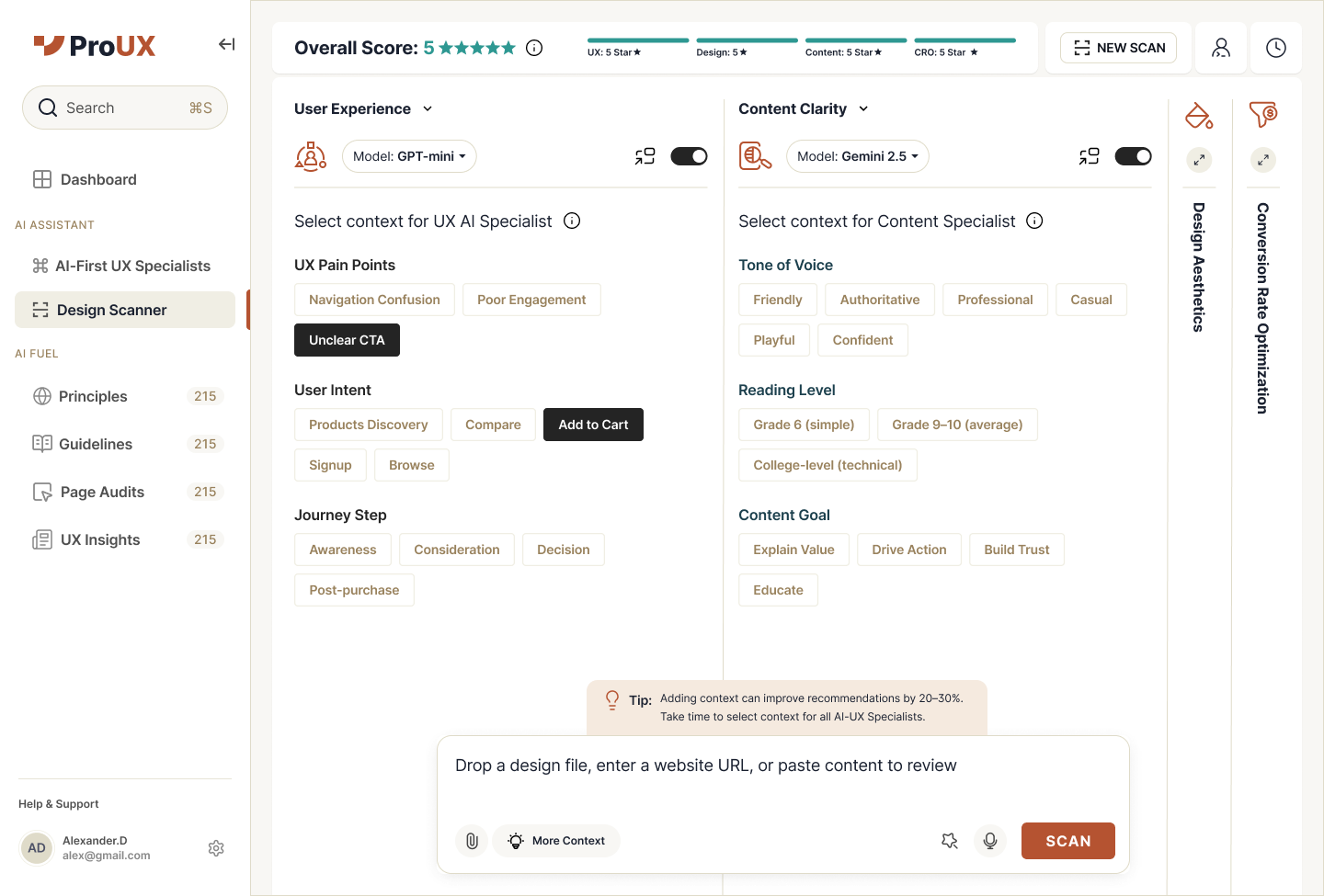
ProUX version 1: pick a UX specialist, a model and context chips, then compare the answers side by side

You chose the specialist, the model and the context, then compared the answers yourself.

Version 2 · rebuilt from the ground up · live

You set the task in plain words. ProUX picks the expert and the model, and runs the method in 1 workspace.

Why I built it twice

I designed and built version 1 myself. Then I ran a usability test with 10 people.

They liked the answers. They found the product complex, closer to traditional software than to the AI tools they use every day.

So I rebuilt ProUX from the ground up, for speed. The engine now makes the choices testers struggled with: you set the task, it picks the expert and the model, runs the method and scores every fix by impact and effort.

That is what you hire. I test early, and I rebuild when users say the shape is wrong.

Surinder Thakur Designed and built ProUX, twice

Your product, next

4 questions I answer in writing before any code. ProUX is how I answered them once.

  • What does it decide?

    The decision

    In ProUX

    Which fix comes first, and what it costs.

    In your product

    The 1 call your users need made.

  • What does it know?

    The evidence

    In ProUX

    Measured pixels and cited guidelines.

    In your product

    Your data, documents and rules. Nothing else.

  • What must it never do?

    The guards

    In ProUX

    It never calls a guess critical.

    In your product

    Limits, approvals and undo, set in code.

  • Why would people trust it?

    The interface

    In ProUX

    A score with its math. A source on every claim.

    In your product

    Screens that show why, and hand over to a person.

Every AI Product Build starts with these 4 answers, in writing, before any code.

How it works

1 call. A proposal in 48 hours. Then a working product.

October 2026

Dubai · Mon to Fri

Book today. Call Mon 5 Oct. Your proposal by Wed 7 Oct.

4.98/5 from 300+ founders

Trusted by founders

The work, in the words of the people who paid for it.

Questions founders ask

Browse all answers →

No. A chatbot replies to a prompt. ProUX runs a task: it picks the expert, with its curated skills, and the model, applies the ProUX method and verified guidelines, scores each fix by impact and effort, and shows its sources. In your product, the same engine acts within limits set in code, with approval and undo.

No. ProUX is the one you can try yourself. I build AI products where the AI has to decide and people have to trust it.

Yes. I designed and built ProUX alone, from the screens to the API and the database. Your engineers can take it over, or I keep building.

The way ProUX does. It works only from what it was given and labels its guesses. Code sets the limits, not the prompt.

The one that fits the job. ProUX runs Claude Sonnet 5, with Voyage for search. Your proposal names the model and the reason.

Open chat, and full autonomy. The first version does 1 narrow task well, inside limits set in code, with approval before it acts and undo after. Autonomy grows only where the data shows it is safe.

30 minutes for the call. Then your data, documents and rules for the evidence layer, and 1 person who can say yes.

Yes. The call starts with a live ProUX audit on a page you choose.

That is where 1 product starts. Your price is fixed in the proposal, after the call and before any work.

Private by default. The proposal names where each piece of data is stored and who can see it.

Couldn’t find what you were looking for?
Email your question

Anyone can generate screens. Let’s build what decides.

30 minutes. No pitch. Your product, then your scope. Your proposal arrives within 48 hours.

  • Projects from $30,000 per product
  • 3 to 4 months
  • 1 product at a time

30 minutes. No pitch. Your product, then your scope.